Posts

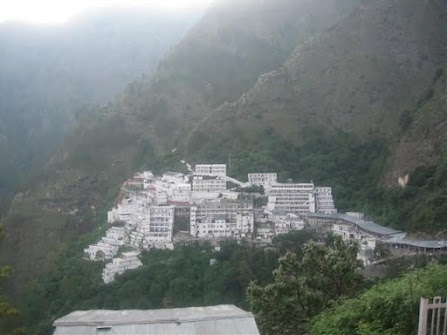
Mata Vaishno Devi- Why it is famous? How to go? Where to stay?
Image
  Vaishno Devi also known as Mata Rani, Trikuta Ambe and Vaishnavi   is a manifestation of the Hindu mother goddess Durga or Adi Shakti. The words " Maa" and     " Mata" are commonly used in India for mother, and thus are often heavily used in connection with goddess.  Mata Vaishno devi took avatar from the combined energies of Mahakali, Mahalaxmi and Maha Saraswati. Why Vaishno devi is famous for? Nestled in the Trikuta mountains. Vaishno devi temple 61 km from Jammu is visited by thousands of devotees every year. The temple is perched at the height of 5200 ft.  A cave temple the shrine houses three sacred pindlis or stone representations of three energy forms, which are worshipped as the aforementioned goddess. Origin of Vaishno Devi? A geological study of this holy cave has indicated that it is almost a million years old. The first mention of this holy cave has indicated that it is almost a million of years old.  The first mention of th...

Shri Kedarnath Dham

Image
Kedarnath temple is one of the sacred  pilgrimage Centre in Northern India, located on the bank of Mandakini river at an altitude of 3584 meters above sea level. The historical name of this region is "Kedar Khand ". Kedarnath temple is a part of Char Dahms and Panch Kedar in Uttarakhand and one of the 12 Jyotirlingas of lord Shiva in India. The temple is located on the Garhwal Himalayan r ange near the Mandakini river in the state of Uttarakhand  , India.  Due to extreme weather conditions the temple is open to general public only between the months of April( Akshaya Tritiya ) and November ( Kartik Purnima, the autumn full moon).  During the time of winter the deity which is called Vigraha of the temple is carried down to Ukhimath to be worshipped for the next six months. Kedarnath is seen as a homogenous form of Shiva the lord of Kedarnath the historical name of the region. History of The Kedarnath The Kedarnath temple is built of massive stone slabs ove...

Gangotri ( The highest temple dedicated to Goddess Ganga)

Image
 Gangotri celebrated place of Hindu pilgrimage in Uttrakhand state in northern India .  It is a town and a Nagar Panchayat in Uttarkashi district in the state of India. It is 99 km from Uttarkashi, the main district headquarter.  It is a Hindu pilgrim town on the banks of the river Bhagirathi . Bhagirathi is the origin of the river Ganges . Gangotri is located on the greater Himalaya Range, at a height of 31000 meters. According to Hindu legend , Goddess Ganga descended here when Lord Shiva released the mighty river from the locks of his hair. Significance of Gangotri On a Chhota Char Dham tour, Gangotri is one of four steps. Gangotri is nestled amidst the beautiful graceful mountains with amazing landscapes. It is one of the most sacred sites due to its close connection to the river Ganga. The river is called Bhagirathi at the source and acquires the name Ganga from Devprayag onwards where it meets Alaknanda. The origin of holy river is at...

Significance of saffron color in Indian saints

Image
  The Scientific reason behind Indian saints wearing Saffron Saffron is a mixture of Red and Yellow. Color red imparts its energy and yellow imparts its happiness to happiness to saffron color. Saffron represents energy, enthusiasm, determination, success, brightness, encouragement and Happiness. Saffron is touted as nothing more than a religious color that holds mythological significance. Basically two reasons are lying behind it:- 1. The color of sunrise and sunset 2. The color of fire The sun and the fire are two significant elements that holds enormous powers. The Seven Chakras :  The seven primal colors are associated to seven chakras of our body. these are Red, Saffron, Yellow, Green , Blue, Indigo and Violet. Every color has different wavelengths and has different impacts on our minds. When we look at them or concentrate on them Time is witness that all the things mentioned and done in Hinduism are all scientific. It is well known to us that the sun nourishes everybod...

APJ Abdul Kalaam ( Essay)

Image
  A.P. J Abdul Kalam is the short form of Avul Pakir Jainulabdeen. Abdul Kalam, who was the 11th President of India and also a great scientist associated with missile and satellite technology. He is fondly remembered today as the missile man of india and the people's president , He is the 11th president of India in the year 2002 and served the country as the president for  the next five years that is 2007. Dr. Kalam's early life:- Dr. Kalam's childhood was very tough as the business run by his family failed and they lost all sources of income . He was born at a poverty- stricken time of his family but managed to overcome all obstacles and worked hard in life to achieve his dream.  He used to sell newspapers to support his family at a very early age. Even though he got average grades in school, his teachers remembered him as a hard-working student with an inquisitive mind. He always focused on mathematics and then after he grew up, He studied Physics, ...

World Environment Day ( Essay)

Image
  In the universe are billions of galaxies, In our galaxy are billions of planets, But there is only one earth   lets take care of it.   Introduction :- Led by the United Nations Environment Programme (UNEP) and held annually on 5th June since 1973. World Environment Day is the largest global platform for environmental public outreach and is celebrated by millions of people across the world.   This day is celebrated to encourage awareness and action for the protection of the environment. It is supported by many non  governmental organizations , businesses, government entities and represents the primary United Nations outreach day supporting the environment. Main Body:-  The day was first observed in 1974 in the city of Spokane in the USA. The day is celebrated by engaging governments, businesses, celebrities and citizens to focus their efforts on a pressing environmental issue . It is a global event observed by around 143 countries.  The mai...

Mohenja-daro

Image
  Mohenjo-daro meaning mound of a dead man. In present-day Mohenja-daro lies in the bank of river Ravi in the province of Sindh, Pakistan.  It was built around 2500 BCE.  It was one of the largest settlements of the Indus Valley Civilization and one of the world's earliest major cities. The word Mohenjo-daro had been because the city of Harappa and important Indus Valley sites was found on a series of mounds over 250 acres of land. At its height, the Indus civilization spanned much of what is now Pakistan and north India, extending westward to the Iranian border, South to Gujrat in India, and northward to an outpost in Bactria. Mohenjo-daro was the most advanced city of its time, with remarkably sophisticated civil engineering and urban planning. Mohenja-daro had a planned layout with a rectilinear building arranged on a grid plan. Most were built of fire and mortared brick. Some incorporated sun-dried mud-brick and wooden superstructures. The city was divided into t...